
ISMAR
Long-jump observation and imagery demo.

Research prototype
LEAP-VR is a configurable research prototype for Meta Quest. Athletes prepare for a long jump, observe a reference movement, and mentally rehearse it from the athlete’s viewpoint without physical running or jumping.
A PETTLEP-grounded virtual reality application for imagery training management in athletics
Prototype views
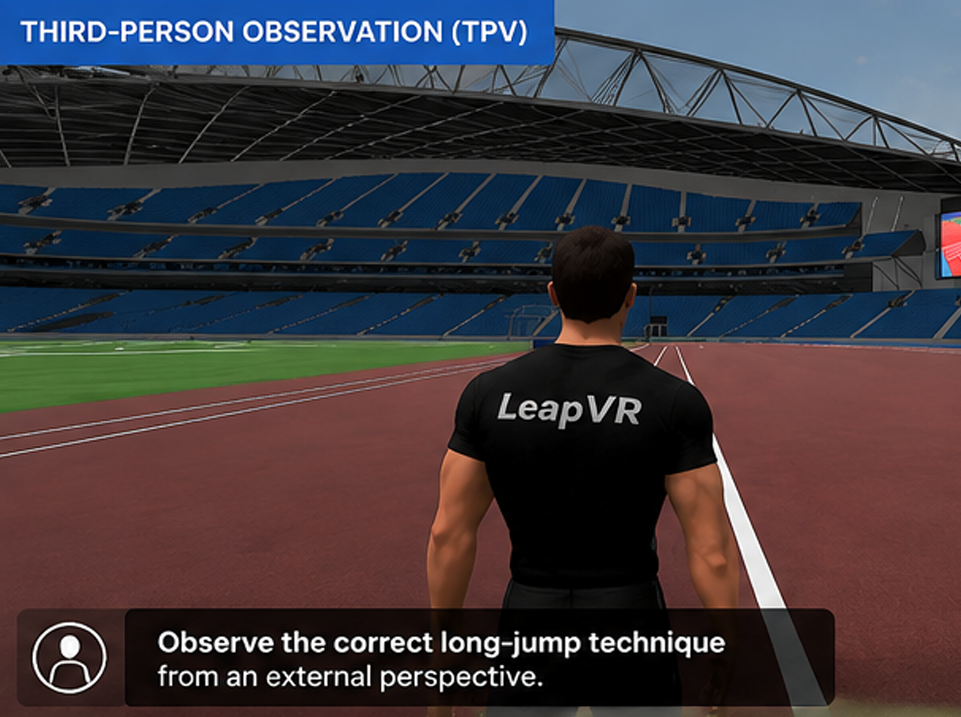
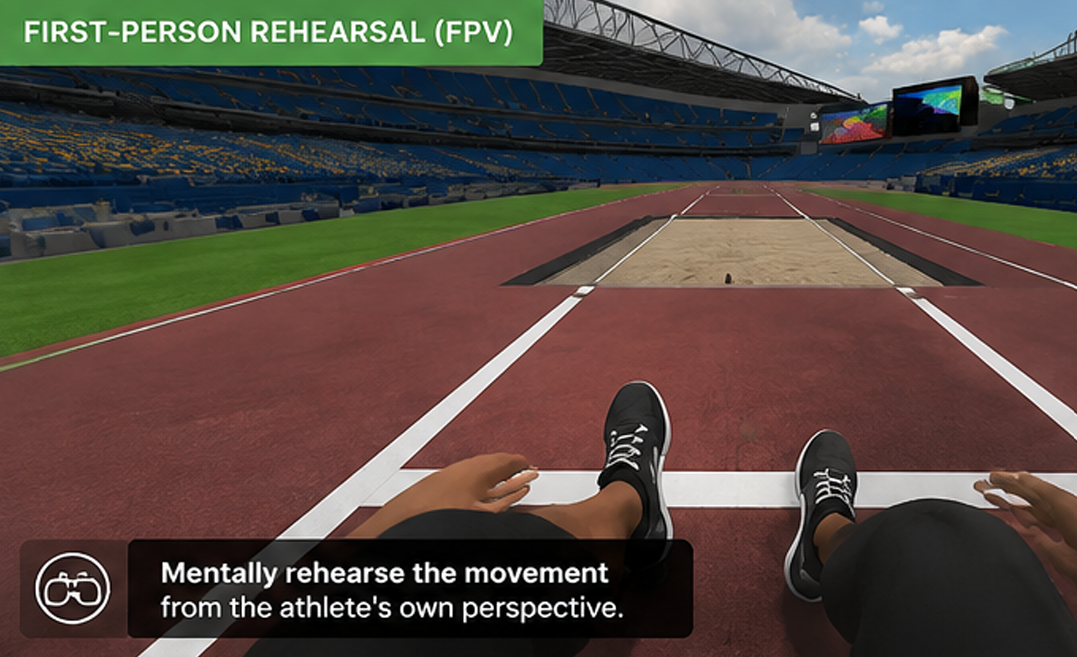
The stadium and long-jump task stay consistent as the viewpoint changes.
Video
A short presentation of the prototype and the long-jump imagery experience.
Session flow
The sequence connects preparation, observation, imagery, and session logging.
Select the avatar, scene, scenario, and preferences. Adjust the visual style and session settings.
Calibrate height and position to align the avatar for correct embodiment.
Use guided breathing to focus attention and regulate arousal.
Complete a short activation sequence to prepare the body and mind for movement.
Observe a technically correct long-jump model from a third-person perspective.
Mentally rehearse the movement from the athlete’s first-person perspective.
Switch between first-person and third-person views to compare and integrate perspectives.
Export the session summary and log data in CSV or JSON format.
LEAP VR family
Separate visual identities distinguish the conference demo, guided breathing, and activation.
Long-jump observation and imagery demo.
Guided breathing for preparation and attention.
A short activation exercise before motor imagery.
Research focus
LEAP-VR applies the PETTLEP framework to a long-jump scenario. Researchers can vary perspective and preparation conditions while keeping the task setting consistent.
Evaluation is planned to examine feasibility, presence, embodiment, and usability. The prototype does not yet establish an improvement in athletic performance.
Conference presentation
The LEAP-VR team presents this demo at this year’s IEEE International Symposium on Mixed and Augmented Reality.
Open for collaboration
We are open to collaborations that help evaluate, extend, and apply LEAP-VR in research.
Studies with sports clubs, coaches, physiotherapists, and athlete populations.
Joint publications and grant proposals, adapting LEAP-VR to different sports, and integrating motion capture.